Saturday, February 1, 2014

The Year of The Horse is Kicking in Orlando!

In case you missed it, 1/31/2014 marks the year of  THE HORSE, in the Chinese calendar.  


“The source of Chinese New Year is itself centuries old and gains significance because of several myths and traditions.” states Wiki.  The reality of Chinese New Year in Orlando, in 2014:  Sulphur clouds, traffic jams, and bizarre entertainers.  I for one was not prepared.


Following up on a friends recommendation an impromptu lunch was planned, meeting at 1101 East Colonial, Chuan Lu Garden.  Arriving near the hour of celebration, noon on New Years day, I attempted to meet my lunch party at Chuan Lu.  My mapping app parked me across the street, in the 1100 block of East Colonial.


As I entered the back of the Tien Hung market (the only thing keeping me from Chuan Lu) the New Year’s festivities began in the front of the store.  Sidewalk blocked and OPD/OFD in force.  I easily understood, with the traffic impact of the pending event, the presence of Orlando’s finest.  Only later would I understand the importance of the Fire Dept presence.  A costly miss on my part.


The market is pretty big.  With hopes of escaping from an exit OTHER than the front door I walked the perimeter of the market.  I was surprised to find an excellent selection of great asian products, a great find.  As a wannabe Foodie, Tien Hung Market is worth a trip back, on ANY other day.


Discovering I was boxed in.  I had no exit.  The front store area was packed with people.  Cell phones taping the entire event.  


I must explain, I am a big guy.  Six and a half feet tall and compared to the patronage of a culturally specific store, I was towering over everyone else.  Couple this with my suit coat and business attire, I was made as some sort of compliance officer, a definite round eye.


The winding parade of exhibitors seemed to be at every turn.


At one point, within the tight aisles of the store layout, a few of the characters squeezed past me.  A symbolic dragon with an escort, half my height, fanned and gyrated as we competed for aisle space.  My attempt to challenge a great restaurant review was turning to the bizarre.



The passing of the characters provided a possible opening at the front door.  The throng of phone taping followers was crowding the entertainment.  


The front door of the market, once blocked by symbol and drum wielding accompaniment, was now unobstructed.  A small crowd, taking snaps at the front counter, my only challenge. I made my move.


Within a few minutes I was at the front door.  I was committed.  The market crowd, costumed characters, musical support and store staff were crowding the front door space.  Seconds later the air erupted with noise.  Strings of firecrackers were lit on the sidewalk, right outside the open market doors.  Clouds of sulphur smoke filled the air.  



Standing a head above the crowd, I took a face full of the smoke.  By the time I fought my way out, through the back door, I was hacking sulphur like a veteran coal miner.


Finding myself back in the 50 degree rainy weather, as a Floridian truly brutal, I called my lunch party.  A few minutes in the rain crossing SR50, betting no one would want to test the strength of their bumper against my 260 pounds, and we were seated at Chuan Lu.  The Sashimi lunch plate was excellent.


I think next year, at noon on Chinese New Year’s Day, I might choose a burger - over sashimi.  

Monday, January 6, 2014

Shoppers With Computers in Hand: A Retailer's Dream Come True


Originally posted on 1-6-2014 at:
http://www.solutionprovidersforretail.com/author.asp?section_id=3488&doc_id=270807&

Wednesday, December 18, 2013

Is your website ready for 2014?

If you are in business in any way, you use the web to interact with your people. Clients, prospects, vendors, and employees -- they are all more effective when they use common, web-based tools to access information. That information flow is vital to the growth and sustainability of businesses of all sizes.

As the year draws to a close, and all eyes turn to the plans for 2014, updating your company's website should make the short list of pending budgeted expenditures. You probably have a website, and an existing URL (Universal Resource Locator) with some good information about your company, and how to contact the right people to get stuff done, place an order, check on an order, talk to someone about a sale, email, or post a kudo or complaint. These functions should be as prominent on your new site as they are on your existing site.

Where your current site is most likely lacking will become more apparent in early 2014. Buyers are going mobile. This is not a new trend, but I believe the 2013 shopping season will provide a true tipping point for mobile adoption. Tablets, phones, phablets, convertible tablets/laptops, and a bevy of wearable tech -- these items comprise the “wish list” for many Santa-seeking gift receivers.

The hardware trickle down theory also applies. As people get the "latest and greatest” toy or device, the last REV ushers a whole new wave of adopters into the mix. On the home front as well as the office, many new users will become truly mobile capable in the first quarter of 2014. I know in my company and home -- as I upgrade -- all my old tech steps down a level, enabling some new function or gadget for the “new” user of my “old" tech.

Some statistics:
  • Fifty-three percent of adult cellphone owners use it to access the Internet
  • A sale coming from mobile phones on eBay comes every two seconds
  • Twenty-eight percent of all Internet usage comes from a mobile phone/device
  • Smartphone sales have become bigger than PC sales
The numbers point to as much as a 60% saturation rate among 18- to 24-year-old users (buyers), as engaged mobile platform users. That is a true tipping point in the market -- more than half of all users expect your website to be a working tool on a mobile device.

The outstanding question is simple: 
How do I ensure my site will work and respond on a mobile device?

As a first step, a "mobile-optimized" site must be rolled up. Google penalizes sites in organic search results when the target site is searched for from a mobile device. This means if you are in the cat food business and you are triggered as the “winning” search response (based on keywords, location, and user generated content/reviews), and you DO NOT have a mobile-optimized site, your next closest competitor with a mobile-optimized site will return as a lead response. Ahead of your listing, in the organic (native) search index.

Reworking your site, as a mobile-optimized resource, is an involved process. Content must be reworked, made presentable on a screen as small as 3.5 inches, and made navigable with gestures rather than clicks. The ability to navigate a maze of information with swipes, touches, and squeezes, is imperative to the project success. Most sites are dependent upon a traditional three point interface (mouse, keyboard, monitor), not a touch interface.

As you work with your integrator, or in house marketing team, be sure to reference a site plan that includes true adaptive/responsive site design tactics. The people/time/money invested will show returns in some unlikely places, as your rally point for information about your company embraces a new wave of mobile buyers and partners.

Wednesday, November 13, 2013

Cryptolocker Virus Can Decimate a Business

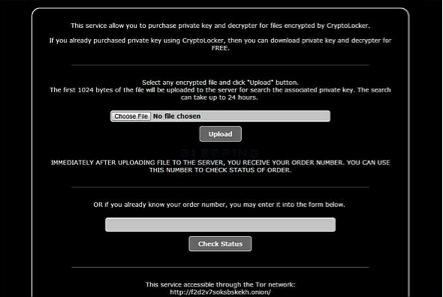
In recent weeks, a new breed of virus has emerged: truly effective “Ransomware." Past iterations of Ransomware, most notably the “FBI Virus” have touted an urgent call to action, involving a transfer of funds, to the group that has infected your computer. The FBI Virus is removable; with the right geek involved, your data was not in jeopardy, the virus could be removed, and your computer returned to a functioning state. The current version of Ransomware, known as “Cryptolocker,” is no joke. Your files are truly gone. The only path to restoration involves paying the ransom, via Bitcoin.


So far, the standard rate for retrieval of your information is two bitcoins. Standard bitcoin exchange rates, averaging about $300 USD per bitcoin, have applied. In the majority of the cases reported, the paying of the ransom actually works. About a thousand PCs a day are infected, though this rate may vary in the future, as known successes are reported in the viral community.

Paul Ducklin, head of technology for the Asia-Pacific region at SOPHOS, described the impact of the virus: “It's kind of like losing your computer or smashing your hard disk or dropping your computer in the harbor. You are never going to get your data back.”

Let me be clear, removing the virus does NOT gain access to your data. The information is locked, not accessible, coded to a specific and complicated key. Cracking the key is a job for geeks armed with supercomputers and dual MBAs and is well beyond the scope of the average SysAdmin or corner computer geek. It is no joke, no post-Halloween spoof. Infected file types range the gamut of often used and critical files, and include documents, databases, spreadsheets, photos, videos, and music collections.

The virus is also written to lock “backed up” versions of the files. The operative function of cross platform infection pivots on real time links between data structures. If you are using a common and widely adopted platform such as Dropbox, iCloud, Google Drive, or SurDoc, then your file storage may also be locked. During the past decade, users have moved away from a truly “cold storage” approach to file protection, but that old-school approach is the best way to combat the current malware attack.

PCs and laptops that are attached, via VPN, or other linked mechanisms are also prime candidates for this viral attack. The virus authors are looking for files that are easy buy decisions for the unlocking keysets. A database of client information, current AR, banking info, ERP and CRM tables, etc. The data types targeted are obvious. This corporate infection strategy is reinforced by a development (in the past week) of a “buy more time” option in the ransom scheme. Initially, a 72-hour window was given, demanding two bitcoins for the unlock key. Now, a “buy more time” option has been given. The upcharge can range into the thousands of dollars (USD), allowing for more time to gather funds to purchase unfettered access to your files.

For personal computer users, an image backup of cold file storage of the to-be-protected data is recommended. USB capable storage is cheap. 32GIG flash drives, in the $30 range, are prolific. I would recommend backing up crucial data as often as needed. The question is, how many days can you afford to lose? Backing up your primary information monthly, at a minimum, is recommended. In the past, corporations and enterprises have used tape backup, some form of shelved cold storage, ensuring information integrity.

Returning to the trends of old, keeping a “cold copy” of primary data is critical. Even when the ransom is paid, there have been cases where the key is not provided. Ironically, the absence of a key, despite ransom payment, is laid at the feet of law enforcement. Should the authorities track the key generating server and shut it down before your key can be generated, your data is still locked.

Monday, November 11, 2013

Sticker Shock: ICAAN's New Rules for TLDs

Creating a website -- currently a fairly inexpensive proposition -- is about to become a lot more costly and complicated.

Nowadays, domain names, starting as low as $3, are readily available and traded openly. Typically, staking a claim to a specific URL or domain name does not present a financial barrier to entry. In fact, even the least technical businessperson can tackle website creation, although hiring a professional will doubtless deliver higher quality results and should take less time.
Regardless of size, financial status, marketshare, or talent, the web offers an inexpensive and readily available platform for users of all types. But volcanic change threatens the equality Tim Berners-Lee envisioned when he crafted the Internet.

Most domain names end in .COM and .ORG; in a “top 100 sites” listing by Ted.com, .COM accounted for half of the primary list. Another 39 used .ORG, while a mix of other top-level domains (TLDs) rounded out the ranking. Under ICANN's new rules, new and distinctive domain names will be released, after review by ICANN. These names will begin to become visible in the greater web in the fourth quarter of 2013.
A highly visible top-level domain, one of the first to gain approval and plan for market release, is.NYC. According to the City of New York’s information page about the .NYC TLD, pricing for these domain names will be based on estimates of related revenue, a model lending itself to more of an auction-based feel than the traditional domain pricing model.

Qualification for acquisition of a .NYC-related domain is also limited. According to City of New York officials, qualified applicants will have a “bona fide presence" in the City of New York, meaning regularly performing lawful activities within the city and maintaining an office or other facility in the city. This is a drastic departure from traditional domain acquisition practices, where anyone with a few dollars can start a named web entity, regardless of location or taxpayer status.

A TLD differs from a traditional domain in its length and its price. New generic top-level domains (GTLDs) change the playing field, allowing for different associations between companies or cities and their web presence. Essentially, the introduction of this new class of domains separates the big players from the little guys. I question not only this fundamental change in the way the web routes naming conventions, but the basic class-level distinction ICANN is allowing to emerge.

You can find the reasoning for this move by looking at ICAAN’s bottom line revenue. According to its FY13 Operating Plan and Budget, ICANN's total operating income was $14.2 million in 2012. However, the organization predicts income of $85.9 million only 12 months later. Six times the operating income, year over year, is enough to entice any company into a new direction. But I question at what cost this increased revenue will come.

If a wave truly becomes a sound at first hearing, then a product becomes a reality at first adoption. Based on the thousands of initial registrants for GLTDs -- despite the massive cost per registrant -- the market apparently believes this new TLD strategy will succeed.

Esther Dyson, founding chairperson of ICANN, states GLTDs "will create jobs [for lawyers, marketers and others] but little extra value." In 2012, the most expensive GLTLD, CDN.net, sold for $185,000, a clear separation from the traditional pricing model for domain names -- the cornerstone of commerce on the web.

The WWW has (for the most part) provided a level playing field for all entrants, regardless of size. True impact has been determined by the masses, nullifying the law of scarcity, and allowing for viral growth of brands and goods based on value -- not marketing might and size of company. How the new GTLD schema will affect search engines, ability to find products, and baseline competition on the web is still largely an unknown. Time will tell as the new web postfixes hit the digital street. Hopefully the final vote, rate of adoption by consumers, will hold the most weight.

Don’t Look Now... Google Glass Will Change Everything

Google Glass is coming, and it’s a large target for many points of controversy.

Given the open architecture Google traditionally uses, the applications for this product will continue to cause much debate while reaching for new heights of integration and digital layover into our daily lives. Competitive wearable-technology products by the likes of Leap Motion and SixthSense, and Kickstarter-based offerings entering into this 21st century gold rush will soon flood the marketplace.

The underlying issue for business of all sizes is how this new technology will impact revenue cycles and buying trends. It’s an issue that has been ignored, surprisingly. But I believe we will see a new trend across all markets and all products, based on this emerging technology.

Prepping your business for this new tech is crucial. The crux of the matter lies in availability, from a digital perspective, to the information that is crucial to buyers. Metrics like competitive analysis, up to-the-minute availability statistics, and auction-based pricing (real-time supply and demand) must be available to the consumer or prospect in order to be accessible to the wearable tech public. The appetite for real-time info will be voracious. Consequently, relying on people, not systems, to update relevant information about products and services will be a fool’s errand.

Welcome to Tommorrowland
I live in a tourist destination, near a hub of international activity -- International Drive, in Orlando, Fla. It’s a mash-up of languages and product offerings ranging from the bizarre to the predictable. I can find them all just a few miles from my front door. I expect, in the near future, wearers of layover technology -- aka Google Glass -- will peruse products and services without ever entering the purveyor’s place of business. Attraction-queue wait times, table wait times, dinner specials, arrivals and departures of local transportation shuttles, room specials -- all types of goods and services being offered by business will be displayed digitally. From afar a prospect may be lured or qualified without ever entering the business in question.

The delivery mechanism for this information will be web-based tech. Regardless of how you build your site (PHP/CSS, WordPress, Twitter Bootstrap, Dreamweaver, or Adobe Suite) all sites will end up with some sort of consumable HTML code structure. Making sure your info is consumable by a wearer-style interface will be crucial. Supplying information that is relevant and current to the user, even more so.

From movable to wearable
Currently this can be achieved by a "mobile capable” web extension -- capability that is already an issue in Google’s organic SEO ranking. But the missing link for many businesses lies in the capture of relevant sale information and the automatic updating of inventory/availability metrics to the mobile capable interface. This may entail tying in a node from a host- or hostess-stand POS (point of sale), enabling wait time information for a restaurant, actively pulling data from a booking engine for demand-rate structure (resort room pricing), demand-based pricing for retail outlets selling hard goods, or service wait times for hair and nail salons.

Traditionally a staff person provides this information to a prospect walking in the door. The prospect inquires about wait time, the hostess answers. This human-to-human interface is lost in the layover marketing world. The opportunity no longer exists. It’s replaced by a visual layover that is only visible with wearable tech.

The tourist market is a prime example of what is coming, but all markets will feel an impact. A layover tech user may get real-time competitive info by looking at a car in a showroom and seeing a list of all competitive offers within five miles. Patients may query information about drugs prescribed, related healthcare information, or wait times in a specific practice’s office. Concerned parents may "check in" on their children at daycare or find their child’s location at a family outing. The implementation of this new technology surpasses privacy concerns and digital tracking.
It will, in fact, change everything.

No Shortcuts Allowed in Website Design

There are some tried and true ways to help prevent against disasters such as that which has befallen healthcare.gov.

Yesterday, in Why HealthCare.Gov Crashed & Burned, & How You Can Avoid That Fate, I touched on the management perils involved with so many contractors as well as site availability concerns. Today, let's look at the difficulties involved in accurate forecasting and dealing with siloed information.

Predicting the number of users for your companies' newly released tools should also be a simple calculation. How many potential users exist? Are you replacing an existing paper-based process? Delving into the existing number of steps and tasks completed daily, with reference to the process, should allow for a "best-case scenari" when launching a new interface or process online. A number of tools exist, allowing for "on demand" scaling of web and LAN/WAN based applications. Your "Go To" geek should be able to address scaling issues with ease, if expected adoption metrics can be estimated.


Dependencies between data silos, a key to failure for healthcare.gov, is a tough nut to crack. Traditionally, paper-based process allow for data staging between steps, normally managed by a well trained employee or team manager. Housing data in specifically crafted spreadsheets or disparate databases allows for a managed flow of information between process steps. Automating these steps well relies heavily on discovery and scope of work for the project. Rules, segmented into a number of "if-then-else" statements, must be carefully crafted. Allowing for the majority of contingencies and access to needed data in real time, taking into account the number of systems included in crafting health care coverage, indeed presents a challenge.

When planning a process for your company, such as price quoting or inventory availability, you must ensure the data needed to calculate the needed information is available in real-time. Depending on a person or department to respond to a needed variable breaks the system of real-time responses to live users.

The bottom line, when outlining a process to be automated, is discovery, scope, and testing:
  • Carefully document the existing process prior to project scope (discovery)
  • Review the process, with the algorithmic replacement of well-trained staff (scope)
  • Diligently run the new tool through end to testing, with the existing process team (testing)
A server is the perfect employee. It does not need sleep or vacation days, does not get jealous when another (better) server sits next to it, and ironically does not need health insurance. Moving your traditionally departmental- or team-based processes to a highly available application or portal is a logical step for any size business.

Healthcare.gov, though imperfect, represents a positive step forward. Using current tools to solve historically tough problems is a tried-and-true method in the world of businesses of all sizes. Hopefully, Washington can continue to improve and modify healthcare.gov. Obviously it is a work in progress.

Why HealthCare.Gov Crashed & Burned, & How You Can Avoid That Fate

Friday, March 29, 2013

EMRs Must Work Together for ARRA to Succeed


Throughout their generations, medical records have promised us lowered costs, increased efficiency, and generally better healthcare. However, despite untold dollars and the efforts of some very smart people, we've yet to realize a fully electronic medical record.

Health information technology is far from a new concept. The first EKG machine, used by Alexander Muirhead in 1872, was designed to bring better medical solutions to ailing patients through technology. Today, technology and medicine are almost inseparable. Machines provide comprehensive data throughout the diagnostic path. Magnetic resonance imaging is an excellent example of the type of analysis that could not be completed without very powerful computers.

Yet most of this industry has yet to achieve full electronic sharing of data between patients, primary care physicians, referring physicians, pharmacists, and laboratories.

The Veterans Administration offers a shining example of what's possible. Its EMR systemreaches or exceeds the goals of digital patient record deployment on all levels. That's because the system's data -- each patient's record -- is usable and viewable by everyone within the patient care system. You have truly available data, from the patient's reporting of the chief complaint (at record origination) through the patient's discharge (or record close). All facets of care are encompassed within the same record and the same system.

In the open healthcare market, health information exchanges (HIEs) are supposed to handle this sharing of records across a common data structure. Regional extension centers were supposed to implement HIEs, which are an integral part of the ARRA/HITECH Act. But this plan has failed -- plain and simple. You can spread the blame widely, and many health IT players are doing just that.

Because of HIEs' lack of success, EMR implementations also are threatened, according to a December 2012 California Healthcare Foundation study. "Given the lack of tangible progress in expanding HIE capacity in California through federally funded programs... it is unclear how meaningful the widespread adoption" of electronic health records will be.

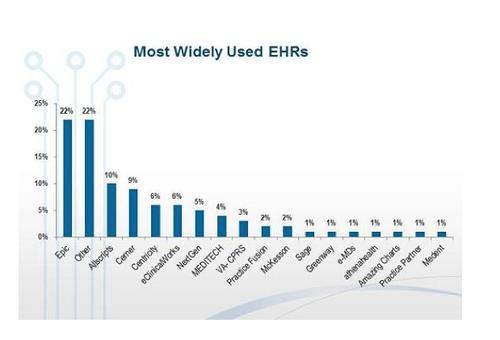
When looking at EMR adoption, ARRA/HITECH advocates cite a Medscape study from August (registration required) that found 74 percent of physicians are using these solutions. But there's a lot of disparity among systems, and a lack of leadership should concern IT professionals. According to the Medscape study, 22 percent of physicians said they use Epic systems, but an equal percentage chose the "other" option. Since no single package has a commanding marketshare, there's no common data structure across healthcare providers. Records are not necessarily accessible from system to system, meaning patients will find their information in silos across healthcare providers. Sound familiar?
No Front Runner in EMRs
Epic is the leader in the EMR market, an August 2012 report found, but there are many contenders.(Source: Medscape)
Epic is the leader in the EMR market, an August 2012 report found, but there are many contenders.
(Source: Medscape)
To realize the promises of procedural efficiencies, reduced costs, and improved care, healthcare itself must recognize something that's true across computing, regardless of industry, type, or size: It has to be easy to share data across platforms. For many generations, documents and spreadsheets have been portable across platforms and between users, irrespective of the relationship between the sharing parties. Any user, from novice to expert, can share media of all types, including videos. However, billions of dollars later, the infrastructure for one set of highly trusted users -- our medical professionals -- is still stymied by this challenge. Healthcare professionals still cannot share digital information between systems.

Frankly, I do not see a cure in the near future. But some sort of exchange medium must be found. We must concoct a common ground for sharing medical data -- for the health of the industry and, more importantly, our citizens.

Sixth Sense Tech + Open-Source = Exciting Opportunities

Sixth Sense Technology is an open-source alternative to Microsoft SurfaceApple's multi-touch, and the Linux MPX Multi Touch. It's also inexpensive and, I believe, mind-blowing and industry-changing.

When Pranav Mistry previewed this technology during an enthralling TED Talk in November 2009, he promised that, one day in the near future, developers would have access to the tools they needed to build their own "Sixth Sense" devices, open-source-style.

Sixth Sense uses hand gestures to control interactions as opposed to a mouse, trackball, or screen. Mistry's goal: To seamlessly connect the virtual and physical worlds in order to make the computing experience more intuitive. As a result, he wanted to remove the digital world from the confines of the smartphone or tablet and bring that world to everyday objects such as paper, walls, and t-shirts. "Rather than getting your camera out of your pocket, you can just do the gesture of taking a photo and it takes a photo for you," he said in the video.
The Future Is Here
In his TED talk, Pranav Mistry demonstrated his open-source-based technology that eliminates the need for typical screens or hardware, and uses 'screens' such as paper, wrists, or walls to display data.
In his TED talk, Pranav Mistry demonstrated his open-source-based technology that eliminates the need for typical screens or hardware, and uses "screens" such as paper, wrists, or walls to display data.

Recently Mistry lived up to his promise of sharing his powerful technology. The code and
hardware component list (HCL) for Sixth Sense are now available. Wearable technology, as defined by Apple, Samsung, Dell, HP, and Microsoft, looks much different than the world Mistry envisioned four years ago. By offering this technology for free and open-source-style, Sixth Sense is definitely not on the same roadmap that the big boys of high tech are traveling.

The components you need to build a Sixth Sense device are both off-the-shelf andinexpensive. They include:
  • Camera to capture the user’s hand movements and gestures, take pictures, and interpret users' “framing” gestures. Approximate cost: $50
  • Projector for output (GUI), giving the ability to use virtually any surface as a “monitor,” as well as augmenting physical objects with real-time content. Approximate cost: $250
  • Mirror measuring 1” x 1” as a physical relay for the projected image. Approximate cost: $5
  • Microphone, used to enable paper as an interactive surface by capturing sound across the paper medium. With current camera tech, the microphone is usually part of the camera apparatus. Approximate cost: $0
  • Mobile computing device -- smartphone or laptop. Approximate cost: Varies
That totals about $300 in hardware, all based on readily available, off-the-shelf components. That's not a huge investment, given the impact of the technology. Currently, no (or perhaps only a few) VARs are marketing Sixth Sense, although I predict this will change -- soon. Packaging the system with software to create a usable bundle of some wearable device at an inexpensive purchase price is inevitable.

Gaming platforms adopted gesture- and voice-based recognition, allowing for free-form game play and voice command for software manipulation. Microsoft, Apple, and BlackBerry accustomed users to control their devices via gesture and swipe commands. Now a new tier of tablet manufacturers can pull up a seat at the mobile table, given the low-cost barrier to entry and the potential market for vertical, specialized, inexpensive models, or diverse new wearable prototypes based on these open-source specs.

The table has been set for a truly intuitive platform to sweep the marketplace. I foresee the release of “Sixth Sense” as a free open-source alternative will have a big effect on an already explosive impact.